
About
Representation
View all Representation →Consultations- Digitisation Taskforce – Final Report
- FCA Consults on Fund Product Information and Cost Disclosure CP24/30 – ShareSoc Responds
- FRC Consults on UK Stewardship Code – ShareSoc Responds
- FCA Consultation – Modernising Redress
- HMRC Consultation – IHT on Pensions
- ShareSoc Evidence to Lords on FCA Enforcement
- ShareSoc supports FCA proposal for criminal background checks on owners and controllers of financial institutions
- UK ISA: ShareSoc submits consultation response
- FCA Consultation on Enforcement Practice & Transparency
- ShareSoc response to House of Commons Education Select Committee
- UKSA and ShareSoc Submission to Labour Party Review of Financial Services
- FCA Consultation GC23/2 Financial Promotions on Social Media
- VIEW ALL CONSULTATIONS
Education
Events
View all Events →Upcoming Events- Oct19SIGnet York Group Launch Meeting
- Oct21ShareSoc Webinar with The European Smaller Companies Trust (ESCT)
- Oct27Asset Match webinar on PISCES: what it means for liquidity in private company shares
- Oct27SIGnet North Leeds / Harrogate / Skipton Group Launch Meeting
- Forums
Your most patient shareholders are the ones you speak to least
Findings from InvestorHub and ShareSoc research into UK private shareholders
Ask most people in the City how long an individual investor holds a stock and you will get an answer measured in weeks. This is a widely accepted assumption that is built into the way UK listed companies run their investor relations: one webinar a year, an annual report, a broker note, and everything else pointed at institutions.
We tested it. InvestorHub, in partnership with ShareSoc, surveyed UK individual shareholders about how long they hold, how much they hold, and how often they want to hear from the companies they own.
The answer was not even close.
Individual investors are not short-term money
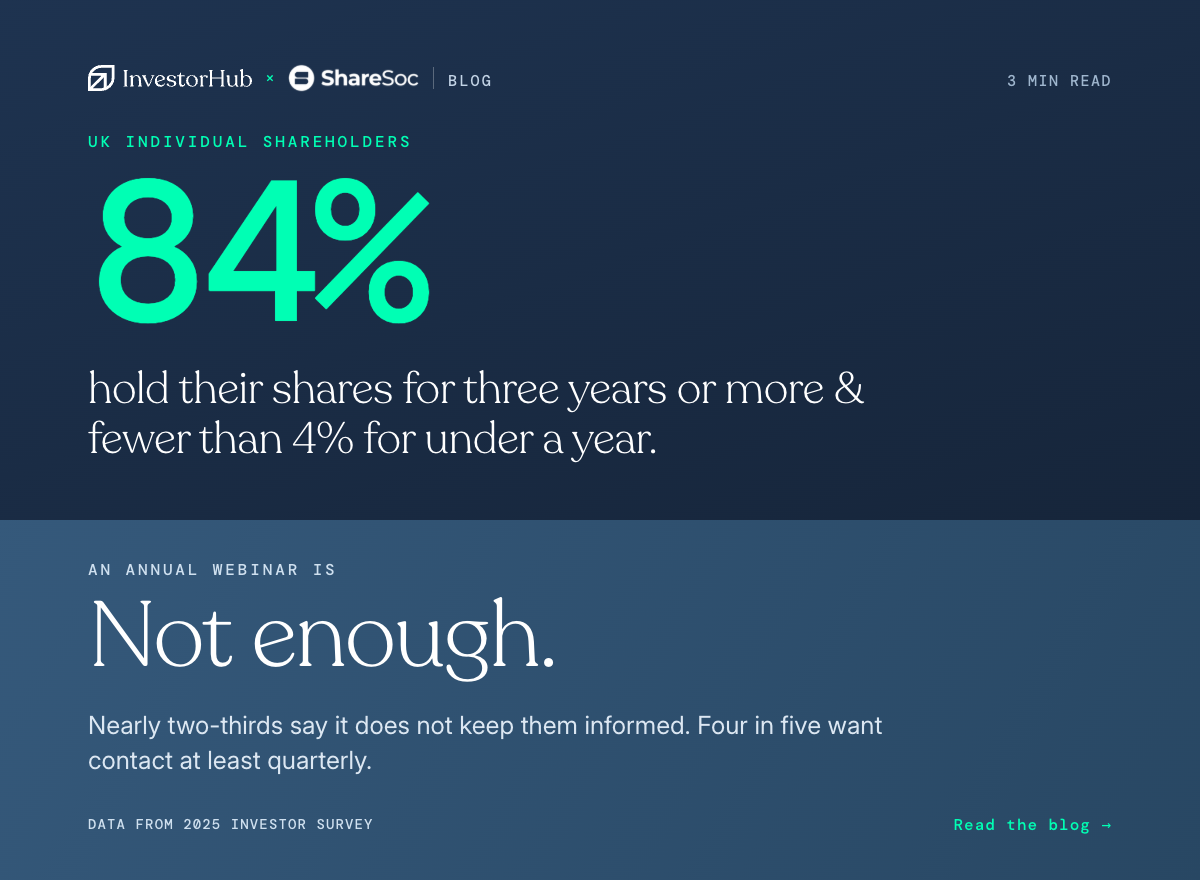
Eighty-four per cent of the individual shareholders we surveyed hold their positions for three years or more, on average:
- 31% hold for three to five years
- 30% hold for five to ten years
- 23% hold for more than ten years
Fewer than 4% hold for less than a year.
Individual investors are a base of long-term holders. On AIM and AQSE, where free floats are thin and institutional coverage is patchy, that loyalty is valuable: a stable stock that is not being recycled every quarter.
The position sizes are not trivial either. The largest single group, 42% of respondents, invests between £10,000 and £50,000 per position. Investors putting in £50,000 to £500,000 cluster in the longest holding bands. In other words, the biggest cheques come from the most patient people.
The gap is in how often companies talk to them
Here is the part that should concern any board. The same research asked these long-term holders whether the standard annual touchpoint is enough.
- Nearly two-thirds told us that an annual webinar is not sufficient to stay informed
- Among investors who regularly attend company webinars, 77% said once a year is inadequate
- 52% want quarterly updates, and a further 28% want monthly contact
So, roughly four in five want to hear from their companies at least quarterly, and most companies are giving them a fraction of that.
This is a legacy of the assumption, not a decision any board made. IR calendars were built around the idea that retail money is transient and modest, therefore not worth a recurring effort. The data says the opposite: the shareholders getting the least attention are the ones staying the longest and are potentially some of the largest holders.
Why this matters more now than it did five years ago
Two things have changed at once. Retail participation in UK equities has grown and, for small and mid-cap companies, is now a material source of liquidity. At the same time UK institutional capital has become more constrained, and coverage of the lower end of the market has thinned out.
That makes the retail register one of the few sources of patient capital an AIM or AQSE-listed company can reach directly. It is also the one with which most companies have no direct relationship. They see their register through a third party, they reach their shareholders through intermediaries, and they have no data on which investors are actually paying attention.
The finding is simple enough to act on this quarter: your individual shareholders are behaving like long-term partners, but most companies are still communicating with them as though they are about to leave.
The research was conducted by InvestorHub in partnership with ShareSoc.
One comment
Leave a Comment Click here to cancel reply.
This site uses Akismet to reduce spam. Learn how your comment data is processed.
Become a free Associate ShareSoc member
Enter your email to sign up as a free Associate ShareSoc member and receive our emails. It takes a few seconds — and on the next page you'll have the option to customise your membership.
This doesn’t really make sense to me – why would someone investing for ten years want monthly updates, especially as nothing much is likely to happen from one month to the next? As someone whose timescale is ten years + I’d say that annual updates are fine, plus extra information if something significant happens. What I would complain about is that a lot of webinars are just bland PR presentations that don’t tell you much.