

1. Minerva briefing on global IPOs
Minerva Analytics’ briefing, Global IPOs: Growth, Governance and Risk, examines the drivers of the IPO revival and the governance questions emerging from it.
Minerva reviews the structural dynamics shaping modern initial public offerings, focusing on how rapid scaling often compromises long-term corporate stewardship. The report highlights that while IPOs remain a vital mechanism for capital raising, governance standards accompanying new listings have deteriorated, posing significant risks to minority shareholders.
A central theme is the normalisation of unequal voting rights, notably dual-class share structures. These frameworks allow founders and pre-IPO backers to retain disproportionate control over the company while significantly reducing their economic exposure. Minerva argues that such structures insulate management from essential investor scrutiny and hinder investors’ ability to effect necessary governance changes.
The briefing also examines the tension between high-growth narratives and sustainable risk management. Fast-growing companies frequently enter public markets with immature board structures, lacking the independent oversight required to navigate complex public compliance, labour relations, and environmental, social, and governance (ESG) obligations. This governance deficit leaves newly listed firms highly vulnerable to operational shocks and regulatory missteps once the initial fanfare subsides.
The paper also touches on varying regulatory environments globally, noting that major stock exchanges are increasingly relaxing their listing rules in a race to attract highly coveted tech unicorns. This regulatory arbitrage ultimately forces investors to accept diminished protections in exchange for access to growth. The report concludes that stronger, standardised board evaluations are essential.
One key element not covered in the Minerva report is the historical investment performance of IPOs. The briefing rigorously scrutinises governance mechanisms and structural risks but omits a quantitative assessment of whether an everyday investor participating in these IPOs would have ultimately received positive long-term returns on their capital.
2. The reality of IPO returns: 1 day to 5 years
Extensive research by financial economist Jay Ritter on IPO performance, updated to span over 9,000 US IPOs from 1980 to 2025, paints a volatile picture for post-market returns.
1 Day (The Pop): Historically, the average first-day “pop” (measured by the closing price as a percentage increase compared to the original IPO issue price) sits at 18.9%. This is highly sensitive to market enthusiasm; in 2024, the average pop was 15.3%, rising to 29.3% in 2025. However, this gain is rarely captured by retail investors, who typically buy at the opening bell on the secondary market after institutional demand has already driven the price up. Furthermore, roughly 16% of IPOs break their issue price and close their first day in the red.
1 Year: After six months, the initial hype fades and early insider lock-up periods expire. By the one-year mark, the average return is roughly 5.6%; momentum often begins to decline as the market demands real earnings in preference to growth projections.
3 Years: By three years, the average IPO has yielded a buy-and-hold return of 21.2% from first close (median –25.7%) and 38.5% from offer price (median –16.6%). Ritter shows an average 3-year market-adjusted return of −20.5% from first close.
5 Years: At five years, the historical average IPO return sits at 37.8% (median –32.0%) from first close (versus 57.2% mean and –22.1% from offer price). The divergence between mean and median highlights a massive dispersion in individual issue performance.
When comparing the major markets, the US has historically generated larger absolute returns, possibly due to its deep capital pools and high concentration of tech companies, which have higher upside.
The UK market has traditionally offered lower first-day pops but focused on more mature, dividend-paying companies. However, in recent years, my feeling is that the UK market exhibits the same structural truth: most IPOs underperform their respective benchmark indices over a three-to-five-year horizon.
Advanced Learning Point: The Mean vs. Median Skew
Understanding the difference between average (mean) and median returns is a critical lesson in IPO investing. While the average 5-year return, measured from first day close, is +37.8%, the median 5-year return is a loss of 32.0%.
This massive divergence occurs because equity returns are asymmetric: a stock can only lose 100% of its value, but it can gain 1,000% or more. The average return is pulled sharply upward by a tiny fraction of “multi-bagger” outliers (e.g., major tech giants) that form a long right tail. Meanwhile, the median reflects the typical investor experience—some 61% of all IPOs produce a negative five-year return, and roughly 43% lose more than half their value.
3. The “IPO strike”
The mechanics of IPO pricing have shifted fundamentally since the 1980s, transforming the IPO from a shared growth opportunity into a liquidity exit.
The historical sweet spot (5%–15% discount)
My personal recollection from the 1980s is that IPO underwriters aimed to price an issue to leave some money on the table for incoming investors. Pricing for a 5% to 15% first-day pop was seen as good practice; it rewarded institutional investors for taking a risk on a newly public entity, generated positive press, and built a loyal shareholder base for long-term growth.
The modern era: maximising the exit
In more recent years, the priority has shifted toward extracting maximum value for departing founders, venture capitalists, and private equity firms. Companies are now staying private for much longer, exhausting their hyper-growth phases in the private markets. By the time they float, their valuations are already priced to perfection.
Two high-profile UK examples illustrate this shift:
- Aston Martin (2018): Floated at an aggressive £5bn valuation, heavily championed by its private equity backers. The company lacked the fundamentals to justify the luxury multiple it demanded. Since its IPO, the share price plummeted by nearly 92% at its lowest point, thoroughly punishing early retail investors.
- Deliveroo (2021): Dubbed “the worst IPO in London’s history,” Markets wiped £2bn off its valuation (a 26% drop) on day one. Its share price continued to decline until it was taken over for £2.9bn in May 2025 (delisted in October), for about 60% less than its £7.6bn IPO valuation.
The result: a UK “IPO strike”
Individual and institutional investors have been burned repeatedly by being treated as exit liquidity for overpriced private equity assets; as a result, a genuine buyer’s strike has formed. UK fund managers now refuse to support new listings unless they are priced at a steep discount to their established market peers. This standoff — where private sellers demand 2021-era premium valuations and public buyers demand deep discounts to mitigate risk — explains the current trickle of new listings on the London Stock Exchange.
4. Recent major UK IPOs
Recent major UK listings valued over £500 million have largely validated concerns over aggressive pricing and poor post-IPO returns. While there are isolated successes, the broader trend for highly valued companies floating since 2020 has been severe underperformance, wiping billions off initial market capitalisations and reinforcing the buyer’s strike mentality among fund managers.
| Company | IPO Date | Issue Price | Initial Valuation | Subsequent Performance |
|---|---|---|---|---|
| THG (The Hut Group) | Sep 2020 | 500p | £5.4bn | Collapsed by over 80%. Shares initially surged past 800p before corporate governance concerns and profit downgrades triggered a massive sell-off. |
| Dr. Martens | Jan 2021 | 370p | £3.7bn | Down over 80% from its issue price. Plagued by supply chain bottlenecks, weakness in the US market, and a series of profit warnings. |
| Moonpig | Feb 2021 | 350p | £1.2bn | Peaked near 480p during the pandemic lockdown but subsequently fell back and has traded significantly below issue price as growth normalised. |
| Deliveroo | Mar 2021 | 390p | £7.6bn | Dropped 26% on its first day of trading and continued to trade well below issue price. |
| CAB Payments | Jul 2023 | 335p | £851m | Issued a severe profit warning just three months post-IPO, sending shares crashing by over 70% to around 60p in what was widely viewed as a disaster for London’s market reputation. |
| Raspberry Pi | Jun 2024 | 280p | £541m | Rare Success: Jumped over 30% on its debut, settling around 400p. A well-priced tech offering that left money on the table for incoming investors. |
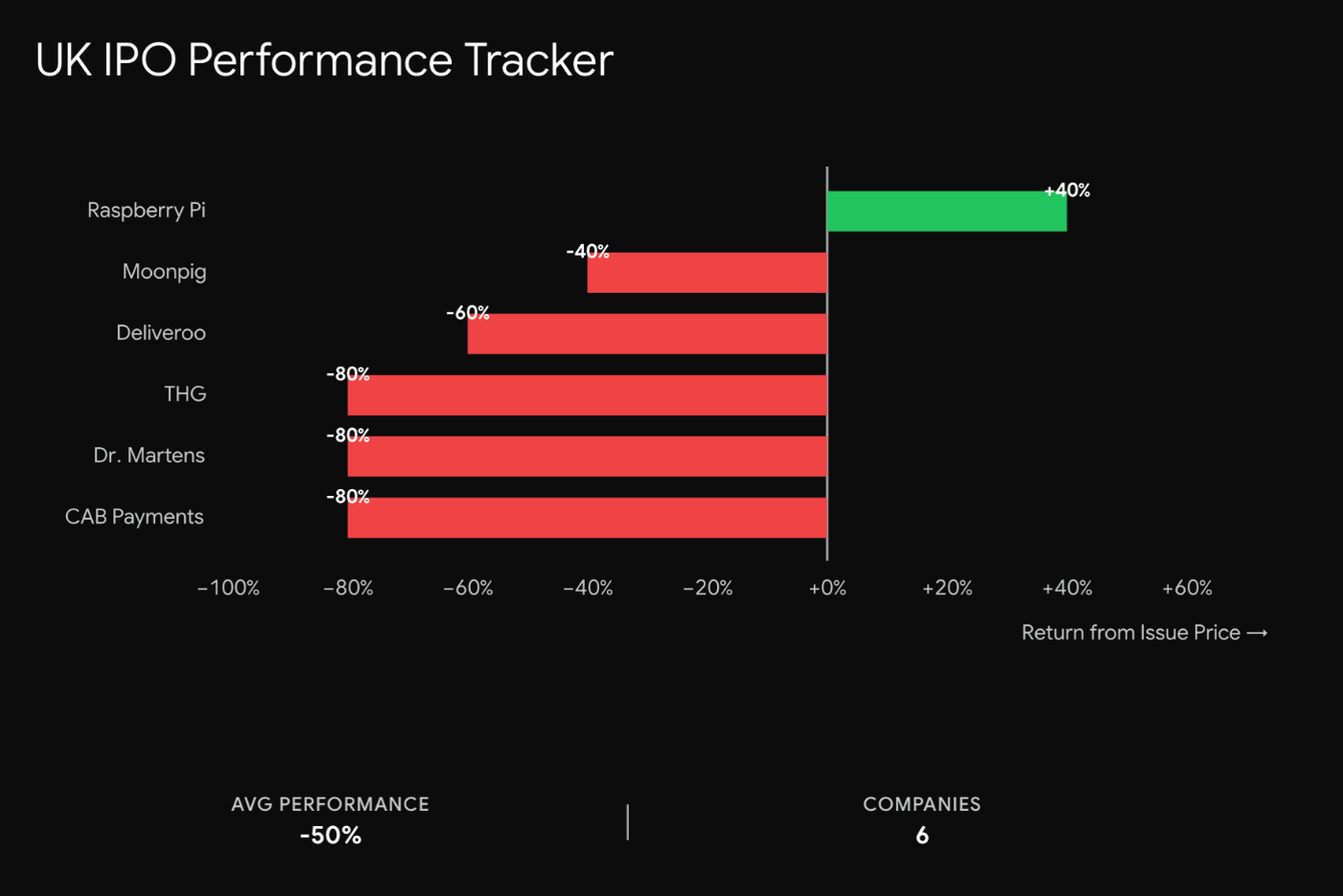
Key insight: Raspberry Pi’s successful 2024 float demonstrated that there is still appetite in the UK market for listings over £500m — provided they are priced reasonably enough to allow public market investors a share of the upside.
Cliff Weight, Chair of ShareSoc’s Education Committee and member of the Policy Committee
This article reflects the opinions of its author and not necessarily those of ShareSoc.