
About
Representation
View all Representation →Consultations- Digitisation Taskforce – Final Report
- FCA Consults on Fund Product Information and Cost Disclosure CP24/30 – ShareSoc Responds
- FRC Consults on UK Stewardship Code – ShareSoc Responds
- FCA Consultation – Modernising Redress
- HMRC Consultation – IHT on Pensions
- ShareSoc Evidence to Lords on FCA Enforcement
- ShareSoc supports FCA proposal for criminal background checks on owners and controllers of financial institutions
- UK ISA: ShareSoc submits consultation response
- FCA Consultation on Enforcement Practice & Transparency
- ShareSoc response to House of Commons Education Select Committee
- UKSA and ShareSoc Submission to Labour Party Review of Financial Services
- FCA Consultation GC23/2 Financial Promotions on Social Media
- VIEW ALL CONSULTATIONS
Education
Events
- Forums
Investors Guide to Investment Trusts

What they are, what they’re for, and why discounts matter
The closed-ended structure explained — its uses, the risks worth knowing, and the feature that most defines it and most often confuses newcomers: the discount to net asset value. With short comparisons to OEICs and ETFs at the end.
The investment trust is one of the oldest ways to invest collectively — the first, Foreign & Colonial, launched in 1868 — and, for many private investors, one of the least understood. It looks like a fund but behaves like a company, and that single fact drives everything distinctive about it.
This post sets out what an investment trust actually is, what it does well, what you need to check before buying one, and the feature that defines the structure and generates most of its opportunity and confusion in equal measure — the discount. Two short sections at the end place trusts alongside OEICs and ETFs.
There is a live reason to revisit all this. Over the past two years several UK trusts trading on wide discounts came under pressure from the US hedge fund Saba Capital, which built stakes and pushed for board changes, wind-downs and conversions. Shareholders — retail holders prominent among them — largely rejected those proposals. The episode was a pointed reminder of what the structure offers, and of how much choice private investors would lose if the sector were materially thinned.
What an investment trust is
An investment trust is a listed company whose business is investing. You buy its shares on the London Stock Exchange, just as you would any other share. The company invests the money it raised at launch in a portfolio set by its mandate, and its directors oversee how that is done.
The defining feature is that it is closed-ended: it has a fixed number of shares. Unlike an open-ended fund, the pool of capital does not grow when investors buy in or shrink when they sell out — shares simply change hands between buyers and sellers in the market. That permanence of capital is the root of almost every advantage and quirk that follows.
Two numbers matter, and they are not the same:
- Net asset value (NAV) — the value of the underlying portfolio, divided by the number of shares. What the trust is worth.
- Share price — what the market will pay for a share, set by supply and demand. What you actually pay.
When the price sits below NAV the shares trade at a discount; above it, a premium. That gap is unique to closed-ended vehicles and is the subject of section 04. The other two structural features to hold in mind: a trust can borrow to invest (gearing), and it is overseen by an independent board of directors answerable to shareholders — neither of which an OEIC or ETF has.
What they’re good for
The closed-ended structure is not merely different; for certain jobs it is genuinely better suited than the open-ended alternatives. Three stand out.
Long-term and illiquid assets
Because its capital is permanent, a trust is never a forced seller. An open-ended fund facing heavy redemptions may have to sell holdings — possibly good ones at bad prices — to return cash to leavers. A trust in the same situation sees its share price fall (the discount widens), but the manager is not compelled to liquidate a single holding. That freedom is what allows trusts to hold genuinely illiquid assets — infrastructure, private equity, unquoted growth companies, property, renewables, specialist debt — that an open-ended fund cannot safely own. For truly alternative strategies, the structure is fundamentally the right one.
Reliable, rising income
Trusts have an income advantage open-ended funds cannot match. A trust may retain up to 15% of the income it receives each year in a revenue reserve, and draw on it in leaner years to keep dividends growing. Open-ended funds must pay out the income they receive, so they cannot smooth. This is why a number of trusts have raised their dividend every year for decades — some for fifty years or more — a record no OEIC can structurally replicate, and a real attraction for investors who depend on the income.
Specialist and differentiated mandates
Gearing, stable capital and a permanent listing let trusts pursue strategies that simply do not fit an open-ended wrapper: concentrated positions, long lock-ups, and access to markets where daily dealing would be impossible. For an investor who wants something beyond mainstream index or active exposure, the choice on offer through trusts is wide — and worth protecting.
The board that answers to you
The single biggest structural advantage of an investment trust is easy to overlook because it is not about assets at all. A trust has an independent board of directors whose legal duty is to its shareholders — not to the fund management firm. In practice that board can:
- Replace the manager if performance disappoints — and boards have done exactly that.
- Negotiate down management fees, or change the fee basis.
- Authorise share buybacks when the discount widens.
- Run tender offers, and put continuation votes and wind-up proposals to shareholders.
OEICs and ETFs have no equivalent. For a private investor, that accountable board is not a technicality — it is the mechanism through which your interests are actually represented, and it was central to how trusts weathered the Saba campaigns.
What you need to know before you buy
Trusts reward a little homework. Five things are worth checking every time.
Check the discount or premium, not just the price
Because the price can sit above or below NAV, you can overpay for a popular trust or pick up assets cheaply in an unloved one. Never buy on price alone: look at where the discount or premium sits today relative to the trust’s own history.
Mind the liquidity
Larger trusts trade freely, but smaller and specialist ones can be thinly traded, with wide bid-offer spreads. Use a limit order rather than a market order so you are not caught out on the price you get.
Gearing cuts both ways
Borrowing to invest magnifies returns when assets rise — and losses when they fall. It also carries a cost that bites hardest when values drop or interest rates climb. Check the level of gearing and treat a heavily geared trust as a higher-risk holding, not a free lunch.
Understand the true cost
Look at the trust’s own ongoing charges figure. Be aware that the way some platforms have historically aggregated a trust’s internal running costs into the numbers shown to investors could make trusts look dearer to hold than they really are; this disclosure has been contested and the rules have been changing. Note too that platforms often treat trusts as shares — frequently a flat custody fee — rather than charging a percentage of the amount held, as they typically do for funds. On a large holding, that difference compounds.
Read the structure
Check the mandate, whether the trust has a fixed life or a periodic continuation vote, its stated discount-control or buyback policy, and — if you are buying for income — the size of its revenue reserve. These are all in the annual report and the factsheet, and they tell you how the trust is likely to behave in the conditions that matter.
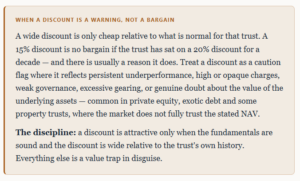
Discounts: the defining feature
More than anything else, it is the discount that sets investment trusts apart — and it is both the structure’s most useful feature and its most common trap.
Why discounts exist
Because a trust’s shares trade independently of its assets, the price can drift away from NAV for any of several reasons:
- Market sentiment and risk appetite
- Sector rotation moving money elsewhere
- Concerns about the level or cost of gearing
- A preference for daily-dealing liquidity
- Uncertainty over the valuation of unquoted holdings
- Doubts about the manager’s record
Discounts are a normal feature of the closed-ended structure, and often cyclical — widening under stress and narrowing as confidence returns.

Discounts tend to mean-revert — but not always
Discounts frequently widen in a sell-off and narrow in a recovery, which is where much of the opportunity lies. But “tend to” is doing real work there: some trusts sit on a structural discount for years. Mean reversion is a tendency to weigh, not a law to bank on.
Buybacks can narrow the discount
Here the board earns its keep. When the discount is wide, directors can buy back shares — and, done below NAV, buybacks are accretive: they lift NAV per share for continuing holders and can help close the discount. It is a lever OEICs and ETFs simply do not have.
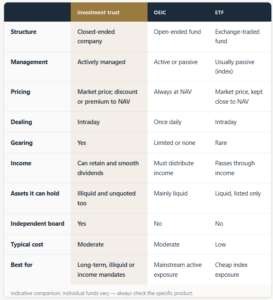
The three structures at a glance
Trusts, OEICs and ETFs all pool investors’ money, but they are built differently — and those differences drive everything else. The trust column is highlighted; the two short comparisons that follow draw out what matters most in each case.
Trusts vs OEICs — in brief
An OEIC (open-ended investment company) is the mainstream fund most investors already hold. It is open-ended: units are created and cancelled as money flows in and out, and it always deals at NAV. That makes it simple and predictable, but it forgoes the features that come from permanent capital. An OEIC cannot gear meaningfully, cannot hold back income to smooth its dividends, and has no board answering to shareholders. Crucially, in a rush for the exits it may be forced to sell good holdings — or even gate investors — to fund redemptions. A trust is never a forced seller: selling pressure widens its discount rather than shrinking its portfolio, which is exactly what lets it hold illiquid assets and take a long view.
These differences show up in the long-run numbers. In a May 2026 study, the Association of Investment Companies (AIC) compared “sister funds” — cases where the same manager runs both a trust and an open-ended fund on a similar mandate. Over twelve months the trust beat its open-ended twin in 41 of 50 pairings; over three years, 36 of 50; over five years, 25 of 47; and over ten years, 27 of 35.

Trusts vs ETFs — in brief
An ETF (exchange-traded fund) also trades on an exchange throughout the day, which invites comparison — but it is a different animal. Most ETFs are passive and low-cost, tracking an index, and a creation-and-redemption mechanism run by authorised participants keeps the price close to NAV. There is no board and no discount to exploit; gearing is rare; and because units must be redeemable daily, an ETF can hold only liquid, listed assets. What you gain is cost and simplicity for broad index exposure; what you give up is active management, gearing, access to illiquid assets, smoothed income and the discount opportunity.
The two are complements, not rivals. An ETF is the efficient way to buy a broad index cheaply. A trust is what you reach for when you want active management, geared exposure, illiquid or alternative assets, smoothed income, or the discount opportunity — none of which an ETF is built to provide. Even in fashionable themes, the contrast holds: a thematic ETF is confined to liquid listed stocks, whereas a specialist trust can own the early-stage, unquoted assets at the heart of the theme.
The bottom line
An investment trust is a listed company built to invest, and its permanent capital gives it a distinctive toolkit: gearing, the freedom to hold illiquid and alternative assets, the ability to smooth income, share buybacks, and — above all — an accountable board. It asks a little more of the buyer than an OEIC or ETF, chiefly around the discount and gearing, but it repays the attention.
The discount, rightly understood, is not a defect but part of the appeal: a chance to buy assets below their worth and capture a re-rating, provided you have done the work on the fundamentals. That is exactly why the Saba episode mattered. A market with fewer investment trusts would be a poorer one for private investors — narrower in choice, weaker in governance, and short of a structure no open-ended fund can replicate. It is a choice worth defending.
By Paul Greenwood, member of the ShareSoc Policy & Campaigns Committee
ShareSoc
ShareSoc — the UK Individual Shareholders Society — is a not-for-profit membership organisation representing and supporting individual investors in UK markets. Find out more at sharesoc.org.
This post is provided for general information and education only. It does not constitute personal investment, financial, legal or tax advice, and nothing in it is a recommendation to buy, hold or sell any particular investment. The worked example is illustrative and simplified; it is not a forecast, and actual outcomes will differ. Investment trusts can use gearing, which magnifies both gains and losses, and their shares can trade at a discount or premium that may widen as well as narrow. The value of investments can fall as well as rise and you may get back less than you invest. Consider taking regulated advice suited to your own circumstances before making investment decisions.

Become a free Associate ShareSoc member
Enter your email to sign up as a free Associate ShareSoc member and receive our emails. It takes a few seconds — and on the next page you'll have the option to customise your membership.