

This blog gives you the latest topical news plus some informal comments on them from ShareSoc’s directors and other contributors. These are the personal comments of the authors and not necessarily the considered views of ShareSoc. The writers may hold shares in the companies mentioned. You can add your own comments on the blog posts, but note that ShareSoc reserves the right to remove or edit comments where they are inappropriate or defamatory.
Another week, another blatant example of the chronic undervaluation of UK small-cap companies, leading to a lowball takeover, that forces long-term individual shareholders out at a lowball valuation.
The AIM market, it seems, is becoming a hunting ground for opportunistic private equity firms to snatch up good businesses on the cheap.
I’ve written about this pattern before with Gusbourne, Dewhurst, and the particularly egregious case of Anexo. The latest name to add to this sorry list is Frenkel Topping (AIM: FEN).
I think this one is particularly cynical. Many ShareSoc members will remember Frenkel Topping presenting at our events some years ago. We heard about the company’s “socially useful purpose”: providing specialist, high-quality financial advice to vulnerable people. These are often individuals who have suffered life-changing injuries, been disabled, and received large compensation payments that need to be carefully invested to last a lifetime.
I, like many others, heard their story in the late 2010s and invested. I believed in the long-term mission and the social good it represented, alongside the investment case.
The long-term view vs. the lowball bid
What has this long-term investment looked like? A picture tells a thousand words. The 10-year share price chart shows a company with potential, peaking in 2021/2022, but it has since fallen significantly.
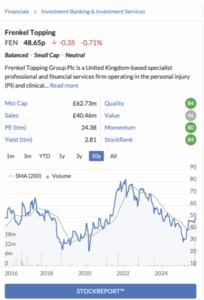
Source: Stockopedia
The RNS itself notes a 43.8% price fall between January 2022 and May 2025. This offer doesn’t reward long-term faith; it opportunistically locks in that recent poor performance, looking to acquire the company at a low ebb.
The Concert Party and the insiders
On 30 September, a “Recommended Offer” was announced. The buyer is an entity called Irwell Bidco, a newly formed company managed by Harwood Private Equity LLP.
This is where it gets complicated.
The Non-Executive Chairman of Frenkel Topping is Christopher Mills. Mr Mills is also the controlling shareholder of Harwood Capital Management (the parent of the buyer) and the CEO and Investment Manager of North Atlantic Smaller Companies Investment Trust (“NASCIT”).
And who is Frenkel Topping’s largest shareholder? You guessed it: NASCIT, which owns 29.96% of the company.
The share register is incredibly concentrated. The RNS confirms that the top ten investors own 78% of the company. The key players, who have already determined the outcome, control 55% of the shares. They are:
- NASCIT (Harwood/Mills Concert Party): 29.96%
- IPGL Limited (irrevocable commitment to accept): 12.68%
- Downing LLP (letter of intent to accept): 8.81%
- Onward Opportunities Ltd (irrevocable commitment to accept): 2.24%
- Independent Directors (irrevocable commitment to accept): 1.97%
The RNS confirms Mr Mills, Harwood, and NASCIT are a “Concert Party.” In simple terms, the Chairman of the company is part of the group buying it, which is already the biggest shareholder. Unsurprisingly, Mr Mills is “not considered independent” and sat out the board’s decision.
This isn’t a takeover in the usual sense; it’s a coercive delisting by insiders.
The “on the cheap” offer
So, what are long-term shareholders being offered for their loyalty?
The “Cash Offer” is 50 pence per share. This is a derisory premium of just 12.9% on the previous day’s closing price and is being dressed up as a ‘voluntary offer’. To make the deal sound more attractive, the offer includes a Contingent Value Right (CVR), offering “up to” another 10 pence. This is a classic “jam tomorrow” fig leaf. This CVR only pays out if Harwood sells the company in the future, and the exit price is above a high hurdle, and after a pile of loan notes and preference shares are paid off first.
The idea of a deferred contingent payout linked to future targets is one that I think can be useful and the example of Hurricane is one when I think it worked well. However, as the RNS itself states: “the minimum payment under the CVR is uncertain and could be zero.”
Worse, for those of us who hold shares in an ISA, this CVR is toxic. It is a complex, unlisted instrument which cannot be held within an ISA wrapper. This means it will have to be transferred to a general trading account, losing all future tax advantages on any (unlikely) payout.
A two-tier system for shareholders
The true insult in this deal is the “Alternative Offer.”
While small shareholders are shuffled out the door with 50p and a near-worthless CVR, the big players are being given another attractive option: roll their shares over into the new, unlisted private company.
And who is taking this option?
NASCIT is rolling over its entire 29.96% stake. Three of the executive directors also intend to roll over a significant portion of their own shares. This tells you everything you need to know. The insiders, the very people who know the company best, are not taking the cash. They clearly believe the company is worth far more than 50p and are positioning themselves to capture all that future upside in the private arena.
The complex Irwell Holdco Unit (a bundle of ordinary shares, preference shares, and loan notes) will also not be allowed in an ISA and may not be permitted by many retail brokerage platforms.
The promise to list these units on TISE (The International Stock Exchange) is hardly reassuring. Anyone familiar with the Woodford case will know what a TISE listing can mean for liquidity and fair valuations – it’s practically useless for minority shareholders.
This ‘alternative’ is clearly designed for the insiders and large institutions that trust the new management, that believe they have the leverage not to be short-changed, and whose fund mandates allow them to hold private equity. It is another example of large shareholders appropriating the future profits of small companies at the expense of small individual shareholders.
My take and a call to action
The “Independent” Directors have unanimously recommended the 50p cash offer as “fair and reasonable,” while explicitly refusing to make any recommendation on the “Alternative Offer” which the insiders are taking.
The deal is, unfortunately, already sewn up given the concentration of ownership and the irrevocable undertakings.
Nevertheless, I have voted against the scheme of arrangement and I urge other shareholders to do so. It won’t make a bean of difference to the outcome, but it will at least send a signal of our deep concern to the board and the regulators.
I have written to the FCA to add this company to my growing list of complaints about the treatment of individual shareholders in these lowball take-privates.
It is no wonder that individual shareholders have gone on strike and refused to invest in UK small caps and AIM. This behaviour will only make the UK’s junior markets even less investible.
The government and regulators need to wake up and increase the attractiveness of UK markets. We need carrots as well as sticks. At present, all the UK Government seems to offer is the stick, such as the rumoured proposal that 50% of ISA investments must be in UK companies if you want to keep the tax breaks. Why would anyone accept such a rule, only to see their UK investments expropriated on the cheap?
So, what would I recommend be done to ensure Individual investors are treated fairly?
- Individual investors need to be better educated to ensure they understand the risks of investing in companies that have large shareholders, that either are or may at some time become a concert party.
- The Takeover Panel should act as soon as it becomes apparent that a concert party is in operation and they should ensure that minority shareholders are given an offer that represents a takeover premium, in contrast to the take-private playbook which ensures minority shareholders have to accept a low ball offer.
- The FCA (and or the Treasury Select Committee) should investigate this and the other similar cases to determine if their existing rules are preserving the rights of minority shareholders or are being arbitraged by the actions of management and other interested parties. The FCA may need to work with The Takeover Panel and possibly others to undertake such a review.
Cliff Weight, ShareSoc member and former director. Cliff is also a member of the ShareSoc Education Committee and the Policy Committee.
Disclaimer: Cliff owns shares in Frenkel Topping and North American Smaller Companies Investment Trust. He bought NASCIT this year as it was trading on what he thought was and still thinks is a large discount to NAV, currently 37.4%.
Initial disclaimer for blog posts: This article reflects the opinions of its author and not necessarily those of ShareSoc
Post Date: November 6, 2025
This site uses Akismet to reduce spam. Learn how your comment data is processed.

Other Blog Posts
- EDUCATION
- MEMBERSHIP
Copyright © 2025 All rights reserved. Sharesoc® (UK Individual Shareholders Society). Terms of use and legal information (note this site uses cookies)
Digital Marketing by Chillibyte.
Digital Marketing by Chillibyte.